
Bob Dylan: The covers
Songs by Sinatra, Cash, Lightfoot, and more

“There’s really only two things you need to know: … One, you have to be nice to other people. [And] the greatest songwriter of modern times is Bob Dylan. That’s all you need to know in life.”
—David Letterman
The talk show host said this in 2015, on his penultimate Late Show, by way of setting up that evening’s musical guest, Mr. Dylan himself. So naturally, what did “the greatest songwriter of modern times” play? A cover.
It’s a classic Dylan move. A little contrarian, a little humble, a little just what he felt like playing at that particular moment in time. But most of all, it reflects the guy’s deep love of song — not just his own, but those of his and seemingly every other era. Since he first started performing a mere 65 or so years ago, he has incorporated other people’s songs into his act, whether playing traditional folk songs in his early days, dropping Woody Guthrie songs into his mid-’70s Rolling Thunder shows, rocking punky blues covers on Letterman in the ‘80s, sprinkling early rock classics into his ‘90s sets, honoring his late friends George Harrison and Warren Zevon in the ‘00s, going on his standards kick in the ‘10s, and finally, covering a bunch of Dead songs in the ‘20s. If he knows it, he might just play it.
His recorded output leans less on covers, but I put together a playlist of my favorites, which I’m sharing in honor of his recent 85th birthday, and the upcoming Austin stop on his summer tour. (I wouldn’t dare miss it!) I’m using the term loosely — there’s a grating moment in A Complete Unknown refers to Bob playing a “cover” of a traditional song, even though no one would have used that term in that way back then — but basically, I considered any song Bob has recorded where he doesn’t have a shared or total songwriting credit. It’s an enjoyable listen — a chance to hear how his tastes and choices have evolved, and how they haven’t. (Seriously, who else has seemingly done the same thing, pursuing the same passion, for so many decades at so high a level?)
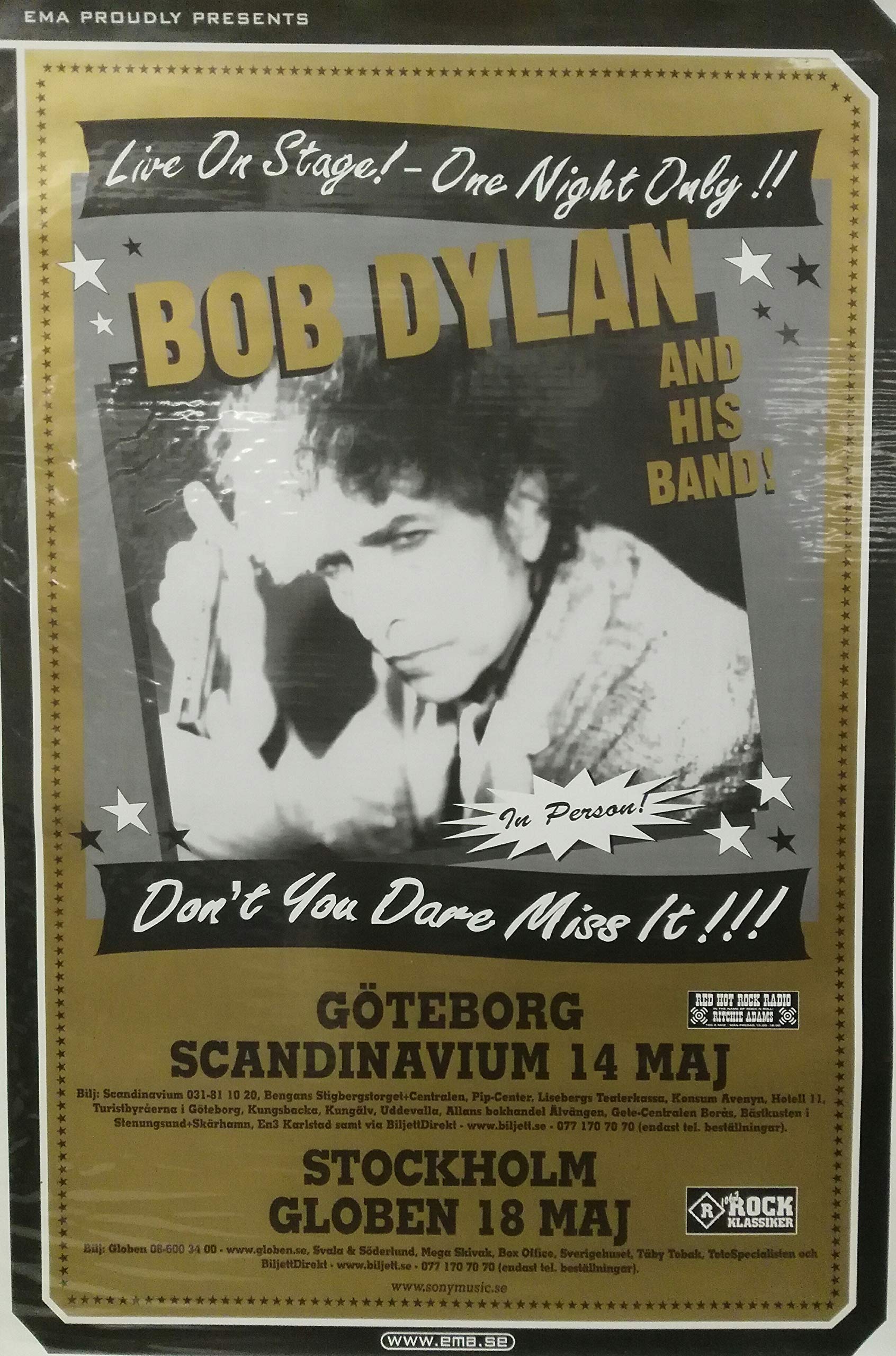
The playlist and liner notes are below. For paid subscribers, I’ve also included a playlist of the originals, where possible, below that.
“Man of Constant Sorrow” [Traditional]
Before Clooney, there was Dylan. And before Bob, there was this song. I mean that literally: When Dylan was born in 1941, this song was already at least a few decades old, having first been published in 1913, and likely played before that. What’s striking is that, compared to his folkie peers, Bob somehow sounds less polished, and more authentic, despite his middle-class upbringing. If his peers were mannered in the style of, say, William Powell, Dylan was a rough-hewn Brando.
“Moonshiner” [Traditional]
As someone once said of Gram Parsons, when Bob Dylan sings something, you believe it. Likely written during Prohibition — when moonshining was a thing — this song was something of an Irish-style drinking song. Folksinger Rolf Cahn added the last verse, and Dylan took it another step — Greil Marcus argued in 1969 that this is his finest vocal performance on record.
“Baby, Let Me Follow You Down” (Live at Free Trade Hall, Manchester, UK - May 17, 1966) [Traditional]
I love this one. In writing it, I learned that its first recording was by Big Bill Broonzy — a George Harrison favorite! — and known as “Don’t Tear My Clothes.” Eric Von Schmidt, who Dylan credits on his first recorded version, rewrote it, refining the original bawdy theme. Then Dylan and the Band, on their notorious 1966 tour — the one where a crowd member called out “Judas!” — electrified it, in every sense of the phrase.
And yet, the song itself isn’t changed — that original charge was there in the ‘30s. Bob and co. just amplified it, that’s all.
“I Don’t Hurt Anymore” [recorded by Hank Snow]
After the tour, Dylan and The Band (minus Levon) famously repaired to Woodstock and invented country-rock at Big Pink, then kept the tapes under wraps for about eight years. (Or 47 years, if you were waiting for an official release of the full sessions.) This lighthearted Hank Snow tune exemplifies the vibe, which informed the visionary songs on Music From Big Pink, and the eventual Basement Tapes album.
“I Ain’t Got No Home” [Woody Guthrie]
Dylan’s 1966 motorcycle crash remains a source of mystery and legend; one consequence is that he didn’t tour again until 1974 (with, who else, The Band). He did, however, play a few one-off gigs, including a Woody Guthrie tribute concert after his idol’s death. Backed by, yes, The Band, he delivers a raucous version of the plaintive original.
“Big River” [Johnny Cash]
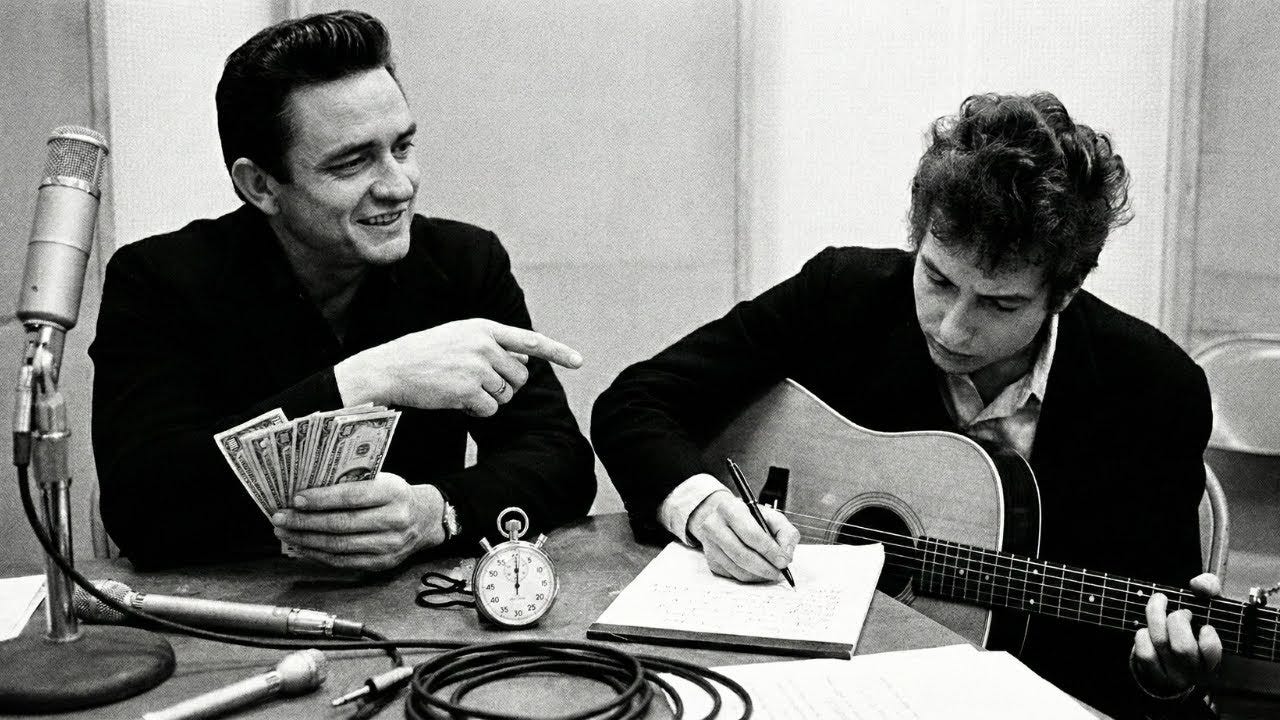
The Cash-Dylan bromance could fill a book, but suffice it to say their mutual admiration society resulted in plenty of iconic recordings, including their duet of “Girl From the North Country” on Nashville Skyline. This take on one of Johnny’s tunes was recorded at the same time, but went officially unreleased for a few decades. Fun fact: Dylan still plays the song, and performed it in Austin last time I saw him. The song’s connection to the Mississippi River no doubt hits home for the Minnesota boy, as we’ll see later in the playlist.
“Wild Mountain Time” (Live with The Band, Isle Of Wight) [Scottish / Irish folk song]
One final performance with The Band. I’m not sure Bob’s ever sounded sweeter. The song has its origins in a Scottish folk song from around 1800, and was later popularized by Irish musician Francis McPeake (with another title).
“Early Mornin’ Rain” [Gordon Lightfoot]
One cool thing is that Dylan’s covers might be, like, a 200-year-old folk song no one else knows, or it might just be a recent-ish song he digs for whatever reason. (In the past few years, he’s covered newer songs by John Mellencamp and Bob Weir.) A charming performance from 1970’s Self Portrait, Dylan’s first studio album with covers since his 1962 debut; he also rocks “Gotta Travel On” and duets with himself (?!) on Simon & Garfunkel’s “The Boxer.”
“Pretty Saro” [Traditional]
Dylan’s country crooner period from 1969 to 1972 or so might be my favorite era of his, at least in terms of voice. This song dates to the early 1700s, before Appalachian folk musician Jean Ritchie rediscovered it. Worth noting that Dylan’s wife at the time was named “Sara,” which probably isn’t a coincidence.
“Spanish Is the Loving Tongue” [Charles Badger Clark]
Another song that was originally a poem, though this 1907 tale comes from a South Dakota cowboy poet, rather than a long-lost Scottish balladeer. This arrangement is kind of nuts; Dylan’s solo piano demo is better, I think, but the sicko in me chose this one for the playlist. It’s from an album Columbia Records released as payback for Dylan briefly leaving his longtime label, and wasn’t intended for release. Make of that what you will, but it’s worth noting he recorded during the Basement Tapes sessions, the Blood on the Tracks sessions, and live in 1976.
“You Wanna Ramble” [Junior Parker]
Be warned: This is ‘80s Dylan, and your mileage may vary. This is a twist on a Junior Parker tune. You can imagine a better, less-synthy version of this song in your head (I hope). If he recorded this for, say, Modern Times, it would’ve been a classic.
“Ninety Miles an Hour (Down a Dead End Street)” [Hank Snow]
The year is 1988, and Dylan still has Hank Snow on his mind. It’s fascinating that, for at least 64 years and counting, this man has devoted his time and energy to one thing: Exploring the breadth and depth of American folk music. Even when the results are just ok, they’re interesting, as with the unusual use of a backing vocal group here.
“Miss the Mississippi” [Jimmie Rodgers]
From the still-unreleased David Bromberg sessions. After a lost period, Dylan spent the early ‘90s recording old folk and blues songs, and took seven years between releasing albums of original songs, while touring nonstop. The process worked: He finally emerged with Time Out of Mind. (And another song, “Mississippi,” which he recorded for those sessions, then re-recorded for 2001’s “Love & Theft.”)
“Step It Up and Go” [Blind Boy Fuller]
Fun story: My wife and I went to see a Levon Helm Ramble in 2011 or so, and wound up with seats right next to Levon’s drum kit. Before he came out to play, I found myself standing next to one of the openers, Happy Traum, a folk icon. He had played this song during his set, and I really dug it, so I worked up the courage to ask him if anyone has a recording of it I should check out — imagining it was some obscure, long-dead bluesman or something. With the most deadpan, are-you-a-total-idiot? voice, he responded simply, “Uh, Bob Dylan.” Anyway: Good tune.
“32-20 Blues - Outtake from ‘World Gone Wrong’ sessions” [Robert Johnson]
Another early ‘90s recording, on that evergreen theme in American music: Shooting your woman.
“Love Henry” [Traditional]
Another early ‘90s recording, on that evergreen theme in American music: Getting murdered by your woman.
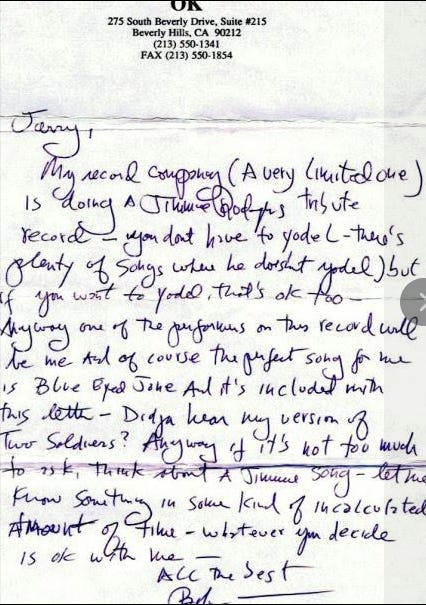
“My Blue Eyed Jane” [Jimmie Rodgers]
At a time when tribute albums were all the rage, Dylan produced one on the great country godfather. His letter to Jerry Garcia, inviting him to participate, is a classic:
“The Water Is Wide” [British folk song]
Believed to be recorded for an as-yet-unreleased Pete Seeger tribute album. (Another tribute album!) U2 fans might know the melody from “Van Diemen’s Land” on Rattle and Hum.
“Cocaine Blues - Live at Filene Center, Vienna, VA - August 1997” [Troy Junius Arnall, arr. by Rev. Gary Davis]
Not the Johnny Cash song. But not not the Johnny Cash song. In the way that folk songs do, this one got changed around over the years, and the two friends performed their own variations of this tune about drugs and murder.
“Return to Me” [Dean Martin]
Dylan’s latter-day reinvention as a crooner starts here, with this Dino classic recorded for The Sopranos. Dylan should sing in foreign languages more often.
“Train Of Love” [Johnny Cash]
Still another tribute album, for Bob’s old pal, The Man in Black. Worth a listen for the tender intro alone.
“Red Cadillac and a Black Mustache” [Warren Smith]
Around this time, Dylan recorded a song for, yes, a tribute album (and documentary): Good Rockin’ Tonight: The Legacy of Sun Records, which feted a half-century of the record label that gave us Elvis, Cash, Carl Perkins and more. Naturally, he recorded a deep cut, “Red Cadillac and a Black Mustache.” Unfortunately, it’s not on streaming at the moment, but you can enjoy it via YouTube. One of my favorite latter-day Dylan recordings, and of a piece with his album “Love & Theft.”
“Gonna Change My Way of Thinking” [Bob Dylan]
I’ll admit this was a borderline inclusion, but the dialog between Bob and his old flame Mavis Staples is too wonderfully corny to skip. The alternate lyrics are choice, too.
“Mutineer” [Warren Zevon]
Oh, look, another tribute album. There might not be any bigger sign of respect for a contemporary singer-songwriter than having Bob Effing Dylan cover one of your songs.
“The Love That Faded” [Hank Williams, kind of]
Similar to Billy Bragg and Wilco’s Mermaid Avenue albums, in which the artists completed unfinished Woody Guthrie songs, Dylan produced this record of unreleased / unfinished Hank Williams pieces, with contributions from Jack White, Lucinda Williams, and others. A fine old country waltz.
“Things We Said Today” [The Beatles]
Given the longstanding relationship between Bob and the Beatles, there’s surprisingly few instances of him recording their songs. (His performance of “Something,” right after George Harrison’s death in 2001, is stunning.) I’ll admit this isn’t one I return to regularly, but it’s certainly an unexpected choice.
“Why Try to Change Me Now” [Frank Sinatra]
In the mid-2010s, Dylan recorded not one, not two, but five albums’ worth of jazz standards, many of them closely identified with Ol’ Blue Eyes. Here’s what he said about Sinatra when the last of these albums, the triple-record Triplicate, was released:
He was funny, we were standing out on his patio at night and he said to me, “You and me, pal, we got blue eyes, we’re from up there,” and he pointed to the stars. “These other bums are from down here.” I remember thinking that he might be right.
“Tombstone Blues” [Bob Dylan]
If you went to a concert, and you later told me it felt like you’d just watched an artist play covers of their own songs, I would assume the concert wasn’t very good. And yet, that’s exactly what Bob Dylan has been doing for 60 years, and it’s been (mostly) riveting for all that time. Like a jazz musician, he’s constantly reinterpreting standards — it just so happens that he also wrote those standards. So let’s close this playlist with Bob covering Bob — a Beat poet-style “Tombstone Blues,” from his pandemic-era live-in-the-studio record, Shadow Kingdom.
And now, a playlist of the originals for paid subscribers only:
Keep reading with a 7-day free trial
Subscribe to Someone Else's Songs to keep reading this post and get 7 days of free access to the full post archives.